Your Cart is empty
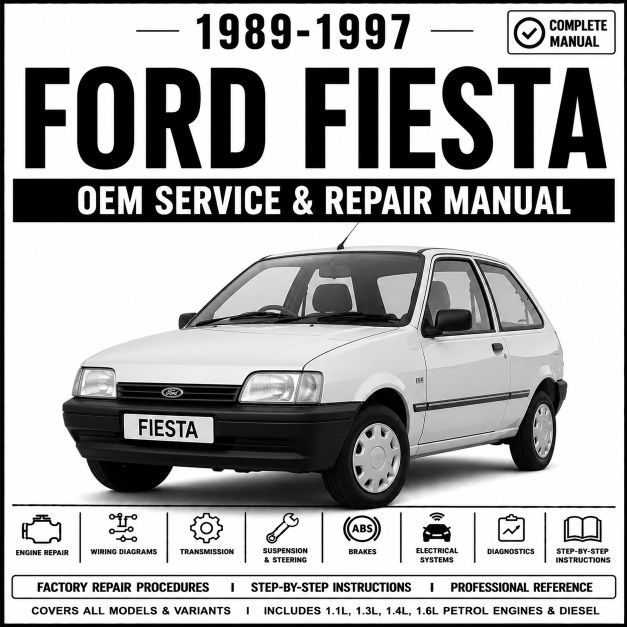
1989-1997 Ford Fiesta Service and Repair Manual
Price: $31.99
Overview
This factory Service and Repair Manual for the 1989-1997 Ford Fiesta (covering the Mark 3 and Mark 4 platform ranges) provides comprehensive technical specifications, diagnostic procedures, troubleshooting information, and step-by-step repair instructions. It covers all major vehicle systems, powertrain variants, transmission options, and electronic control systems available for this model year range.
The manual includes complete mechanical repair procedures, electrical wiring diagrams, troubleshooting charts, transmission service information, braking system repairs, and central body electronics diagnostics.
Whether you are a professional technician, workshop owner, automotive student, or DIY enthusiast, this manual provides the information needed to diagnose, service, maintain, and repair the 1989-1997 Ford Fiesta.
What you get;
✓ Genuine factory workshop manual
✓ Comprehensive diagnostic procedures
✓ Complete wiring diagrams
✓ Covers all major systems and components
✓ We review every manual to ensure it’s genuine and safe for download
Download via eManualOnline
You will be redirected to the official eManualOnline diagnostic archive. Your payment is securely processed on their encrypted network for instant download.
This 1989-1997 Ford Fiesta Service and Repair Manual Covers
Engine and Drivetrain
-
- 1.0L, 1.1L, and 1.3L HCS (High Compression Swirl) pushrod engine mechanical overhauls and valve clearance settings
- 1.4L and 1.6L CVH (Compound Valve-angle Hemispherical) engine block assemblies and timing belt procedures
- 1.6L and 1.8L Zeta / Zetec 16V DOHC engine overhauls, hydraulic lifter testing, and twin-cam timing alignments
- 1.25L and 1.4L Zetec-SE aluminum engine mechanical overhauls, torque-to-yield specs, and specific belt layouts
- 1.8L naturally aspirated and turbocharged diesel engine overhauls, mechanical injection pump timing, and glow plug testing
- TLDM and TLD carburetors, choke linkages, float level measurements, and idle mixture adjustments
- CFI (Central Fuel Injection) single-point and EFI (Electronic Fuel Injection) multi-point system diagnostics
- Ford EEC-IV (pulse diagnostics) and early EEC-V engine management configurations, sensor operations, and actuator test values
- Engine cooling system parameters, thermoswitch operations, mechanical water pumps, and radiator replacements
- Exhaust system layouts, catalytic converter checking, and early single unheated or heated oxygen sensor loops
- Ford BC5 5-speed and early 4-speed manual gearbox overhauls, selector linkages, and clutch adjustments
- CTX continuously variable transmission (CVT) fluid requirements, drive belt tracks, and hydraulic pressure controls
- Front-wheel-drive CV axle shaft replacements, constant velocity boot renewals, and hub attachment specs
Chassis and Suspension
-
- MacPherson strut front suspension layouts, coil spring removal, track control arms, and anti-roll bar links
- Trailing arm rear suspension layouts with a torsion beam axle, rear hub spindles, and coil-over shock absorbers
- Manual rack and pinion steering gears and early hydraulic power-assisted steering (PAS) pump pressure checks
- Wheel alignment factory specifications, front track adjustments, toe tolerances, and rear check dimensions
- Front wheel bearing taper roller split adjustment packs and rear wheel bearing cup/cone replacements
Braking Systems
-
- Early mechanical or hydraulic ABS module valve blocks, actuator links, and speed sensor air gap specs
- Brake master cylinder overhauls, vacuum power booster pushrod settings, and line fluid bleeding sequences
- Mechanical handbrake lever floor mounts, steel cable link tension adjusters, and rear drum shoe connections
- Front solid or ventilated braking disc rotor machining wear tolerances and caliper slider pin cleaning
- Rear drum self-adjuster mechanism diagnostics, wheel cylinder renewals, and shoe lining metrics
Electrical and Wiring
-
- Complete factory electrical wiring schematics, grounding connection paths, and harness terminal points
- Power distribution layouts, engine bay high-current fusible links, and passenger cabin fuse boxes
- PATS (Passive Anti-Theft System) early engine immobilizer logic, transponder key testing, and ignition loop diagnostics (introduced mid-90s)
- Central locking module connections, front/rear actuator solenoids, and power window regulator circuits
- Analog instrument cluster pinouts, mechanical speedo cable routing, voltage stabilizers, and warning lamp connections
- Audio head unit wiring layouts, dashboard clock circuits, and multi-function steering column stalk logic
Air Conditioning and HVAC
-
- Manual slider heater control cable adjustments and early optional air conditioning system setups
- HVAC air blend flap paths, dashboard fresh air distribution vents, and fan motor speed resistors
- R12 refrigerant capacities and early factory R134a conversion procedures, oils, and pressures
- Heater core swap workflows, matrix chemical flushing, and blower motor replacement steps
Body and Interior
-
- Interior door trim panel removal steps, center console assemblies, and headliner card removals
- Standard cloth seats, XR2i / RS Turbo Recaro sport seat tracks, and rear split-folding backrest latches
- Bonnet lock cable releases, tailgate latch solenoids, and glass weatherstripping channels
- External steel panel lines, bumper bar structural brackets, grilles, and headlight aiming specifications
- Supplemental Restraint System (SRS) mechanical or early electronic clocksprings and front driver airbags (introduced mid-90s)
Diagnostics and Troubleshooting
-
- Ford STAR tester analog pulse outputs, jumper wire blink codes, and early NGS scan tool connections
- Self-test diagnostic data link connector locations (under-bonnet or cabin) and fault readout triggers
- Mechanical fuel rail pressure test values, engine cylinder compression baselines, and vacuum gauge testing
- Systematic engine crank but no-start troubleshooting logic trees
Common Error Codes Covered
This manual provides diagnostic and repair procedures for early Ford two-digit and three-digit fault codes (where computerized fuel systems are equipped), including:
Engine Codes
-
- Code 11 / 111: System Pass / No Faults Detected (EEC-IV pulse diagnostic logic baselines)
- Code 41 / 172: Oxygen Sensor Indicates System Lean / No Switching Detected
- Code 21 / 116: Engine Coolant Temperature (ECT) Sensor Signal Out of Range
- Code 23 / 121: Throttle Position Sensor (TPS) Voltage Out of Self-Test Range
- Code 95 / 542: Fuel Pump Secondary Circuit Failure / Open Circuit Detected
Mechanical System Diagnostics
-
- Ignition Module Faults: Pinpoint testing paths for tracking loss of signal at the TFI or EDIS module.
- Mechanical Fuel Pump Testing: Delivery rate and pressure testing metrics for standard carburetor fuel pumps.
- Distributor Advance Failure: Measuring steps for checking centrifugal or vacuum load advance systems on early HCS and CVH engines.
ABS and Chassis Faults
-
- Code 21: Front Right Wheel Speed Sensor Circuit Failure or Air Gap Fault
- Code 25: Rear Left Wheel Speed Sensor Circuit Failure or Sensor Ring Damage
- Code 61: Hydraulic Pump Motor Relay Circuit Open or Grounded
Body Control and Anti-Theft Diagnostics
-
- PATS Validation Mismatch: Continuity test sequences for checking communication logs between key transponder loops and the control circuit.
- Central Locking Loop Faults: Voltage testing pathways for short circuits inside the front door lock microswitches.
And thousands of additional diagnostic codes, test procedures, wiring diagrams, and repair instructions.
This manual is ideal for:
-
- Professional automotive workshops
- Independent repair garages
- Mobile mechanics
- Automotive technicians
- Vehicle owners performing DIY repairs
- Automotive training institutions
If you are troubleshooting, maintaining, servicing, or repairing a 1989-1997 Ford Fiesta, this is the factory workshop manual you need.
Model Years Covered;
1989 Ford Fiesta
1990 Ford Fiesta
1991 Ford Fiesta
1992 Ford Fiesta
1993 Ford Fiesta
1994 Ford Fiesta
1995 Ford Fiesta
1996 Ford Fiesta
1997 Ford Fiesta
Download the Complete Manual via eManualOnline
You will be redirected to the official eManualOnline diagnostic archive. Your payment is securely processed on their encrypted network for instant download.
No reviews yet. Be the first to review this product.
Returns accepted within 30 days of delivery. See our returns policy for full details.