Your Cart is empty
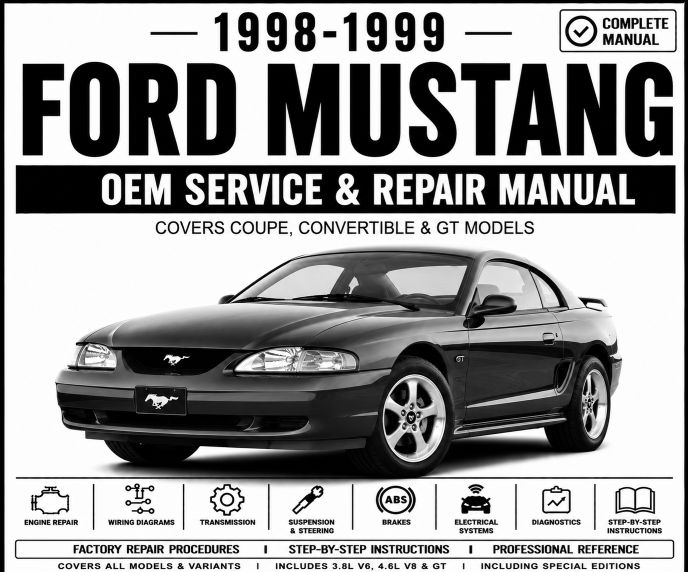
1998-1999 Ford Mustang Service and Repair Manual
Price: $41.99
Overview
This factory Service and Repair Manual for the 1998-1999 Ford Mustang provides comprehensive technical specifications, diagnostic procedures, troubleshooting information, and step-by-step repair instructions. It covers all major vehicle systems, powertrain variants, transmission options, and electronic control systems available for these model years.
The manual includes complete mechanical repair procedures, electrical wiring diagrams, diagnostic trouble code (DTC) troubleshooting, transmission service information, braking system repairs, and generic electronic module (GEM) diagnostics.
Whether you are a professional technician, workshop owner, automotive student, or DIY enthusiast, this manual provides the information needed to diagnose, service, maintain, and repair the 1998-1999 Ford Mustang.
What you get;
✓ Genuine factory workshop manual
✓ Comprehensive diagnostic procedures
✓ Complete wiring diagrams
✓ Covers all major systems and components
✓ We review every manual to ensure it’s genuine and safe for download
Download via eManualOnline
You will be redirected to the official eManualOnline diagnostic archive. Your payment is securely processed on their encrypted network for instant download.
This 1998-1999 Ford Mustang Service and Repair Manual Covers
Engine and Drivetrain
- Complete repair procedures for the actual engines fitted to the vehicle: (3.8L OHV V6, 4.6L 2-Valve Modular V8, and 4.6L 4-Valve DOHC Modular V8 for SVT Cobra models)
- Fuel injection system diagnostics and repair procedures (Transition from return-style fuel rails in 1998 to returnless electronic fuel injection setups in 1999)
- Engine cooling system service specifications
- Exhaust and emissions control system repairs (including secondary air injection and traditional EGR workflows)
- Transmission overhaul and troubleshooting procedures for the fitted transmission(s) (BorgWarner/Tremec T5 5-speed manual, Tremec T45 5-speed manual, and 4R70W 4-speed automatic options)
- Driveshaft, differential, transfer case, and axle service procedures where applicable (including Ford 7.5-inch and 8.8-inch solid rear axles, alongside the introduction of the independent rear suspension assembly for the 1999 SVT Cobra)
Chassis and Suspension
- Front suspension repair procedures specific to the SN95 platform generation (Modified MacPherson strut layout with separate coil-on-lower-arm configurations)
- Rear suspension repair procedures specific to the SN95 platform generation (4-bar link live rear axle setup with quad-shocks, or the dual-wishbone independent rear suspension specific to 1999 SVT Cobra configurations)
- Steering system diagnostics and service specifications (Traditional engine-driven hydraulic power steering pump, high-pressure lines, and rack-and-pinion assembly workflows)
- Wheel alignment specifications and adjustment procedures
- Wheel bearing replacement procedures
- Suspension component diagnostics and troubleshooting
Braking Systems
- ABS diagnostic procedures (including Bosch/Teves ABS module isolation testing)
- Brake hydraulic system service specifications
- Traction Assist diagnostics (Early passive traction control system variants and electronic actuator switch integration)
- Parking brake service procedures
- Brake component inspection and replacement procedures (Standard single-piston base setups, dual-piston GT brakes, and multi-piston Brembo or PBR brake designs used on performance trims)
Electrical and Wiring
- Complete factory wiring diagrams
- Battery, charging, and starting system diagnostics
- Generic Electronic Module (GEM) diagnostics and configuration procedures (Managing power windows, wipers, and interior illumination logic)
- Passive Anti-Theft System (PATS) transceiver key matching and troubleshooting
- Power distribution and fuse box schematics
- Lighting system diagnostics (Transition from 1998 contoured lens headlamps to the 1999 “New Edge” clear lens dual-beam styling and multi-chamber sharp vertical taillights)
- Audio system troubleshooting (Premium Mach 460 multi-amp sound system configurations with cassette and CD head units)
Air Conditioning and HVAC
- Climate control system diagnostics (Manual cable-driven and vacuum-actuated blend door assemblies)
- HVAC component replacement procedures
- Refrigerant specifications and servicing procedures (R-134a charging systems)
- Heating and ventilation system troubleshooting
Body and Interior
- Interior trim removal and installation procedures (including manual/power convertible top canvas mapping and lift cylinder tracking)
- Exterior body repair information (SN95 platform structural steel frameworks, 1998 traditional rounded body configurations, and 1999 “New Edge” generation sharp-edge body structure variations)
- Door, window, and locking system diagnostics
- Lighting system repairs
- Airbag and occupant restraint system service procedures
Diagnostics and Troubleshooting
- Diagnostic Trouble Code (DTC) lookup procedures
- Manufacturer-specific scan tool procedures (Ford Worldwide Diagnostic System [WDS] and legacy New Generation Star [NGS] tester logic)
- Component testing specifications
- Step-by-step troubleshooting workflows
- Control module diagnostic procedures
Common Error Codes Covered
This manual provides diagnostic and repair procedures for thousands of manufacturer-specific fault codes, including:
Engine Codes
- P0300: Random/Multiple Cylinder Misfire Detected
- P0455: Evaporative Emission System Leak Detected (Gross Leak)
- P0171: System Too Lean (Bank 1)
- P0401: Exhaust Gas Recirculation (EGR) Flow Insufficient Detected
- P1285: Cylinder Head Overtemperature Condition Indicated (Critical diagnostic routine for 4.6L Modular V8 configurations)
Transmission Codes
- P0731: Gear 1 Incorrect Ratio (Common 4R70W automatic transmission diagnostic)
- P0741: Torque Converter Clutch (TCC) Circuit Performance or Stuck Off
- P0751: Shift Solenoid “A” Performance or Stuck Off
ABS and Chassis Codes
- C1095: ABS Hydraulic Pump Motor Circuit Failure
- C1145: Right Front Wheel Speed Sensor Input Circuit Failure
- C1233: Left Front Wheel Speed Sensor Input Signal Missing
Network Communication Codes
- U1000: SCP (Standard Corporate Protocol) Invalid or Missing Data for Primary Id
- U1262: SCP (Standard Corporate Protocol) Communication Bus Fault
Body Control Codes
- B1318: Battery Voltage Low (Commonly flagged entry inside the GEM module configuration)
- B1600: PATS (Passive Anti-Theft System) Ignition Key Transponder Signal Not Received
And thousands of additional diagnostic codes, test procedures, wiring diagrams, and repair instructions.
This manual is ideal for:
- Professional automotive workshops
- Independent repair garages
- Mobile mechanics
- Automotive technicians
- Vehicle owners performing DIY repairs
- Automotive training institutions
If you are troubleshooting, maintaining, servicing, or repairing a 1998-1999 Ford Mustang, this is the factory workshop manual you need.
Download the Complete Manual via eManualOnline
You will be redirected to the official eManualOnline diagnostic archive. Your payment is securely processed on their encrypted network for instant download.
No reviews yet. Be the first to review this product.
Returns accepted within 30 days of delivery. See our returns policy for full details.